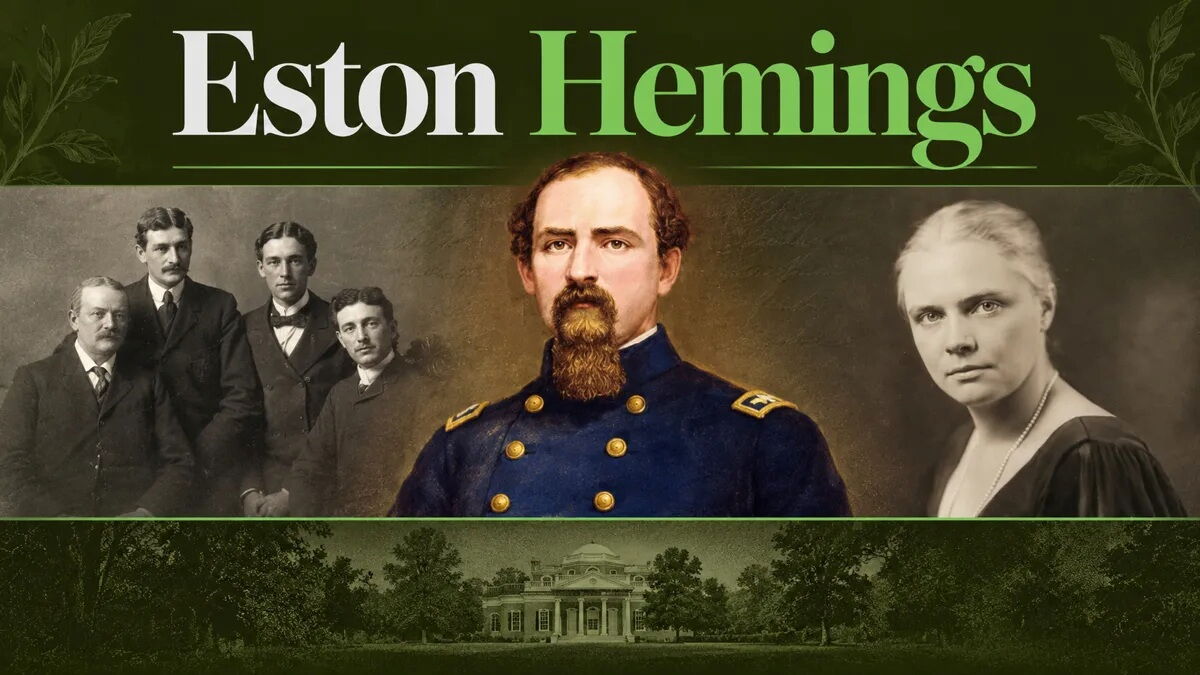
Basic Information
| Field | Details |
|---|---|
| Name | Eston Hemings (later Eston Hemings Jefferson) |
| Birth | May 21, 1808, Monticello, Albemarle County, Virginia |
| Death | January 3, 1856, Madison, Wisconsin |
| Mother | Sally Hemings (c. 1773–1835) |
| Probable Father | A Jefferson male; most evidence points to Thomas Jefferson |
| Spouse | Julia Ann Isaacs (married 1832) |
| Children | John Wayles Jefferson; Anna (Anne) Wayles Jefferson (Pearson); Beverley (Beverly Frederick) Jefferson |
| Occupations | Cabinetmaker/carpenter; violinist and bandleader; hotel work |
| Residences | Monticello (VA); Charlottesville (VA); Chillicothe (OH); Madison (WI) |
| Burial | Forest Hill Cemetery, Madison, Wisconsin |
Origins at Monticello
Eston Hemings entered the world at Monticello, the mountaintop home that loomed over early American politics like a lighthouse. He was the youngest surviving child of Sally Hemings, part of the extended Hemings family that helped sustain the plantation’s daily rhythm and its refined craftsmanship. As a boy, Eston trained under his uncle John Hemings, a master woodworker whose hands shaped Jefferson’s designs into enduring furniture and fine architectural details. In the workshops at Monticello, Eston absorbed a language of dovetails, chisels, symmetry, and patience—a vocabulary that would carry him through life.
The question of paternity haunted the Hemings children like a shadow cast by the dome of the house itself. Plantation records, timing, and later recollections pointed to a Jefferson male; across time, the balance of evidence settled on Thomas Jefferson as the likely father. Whatever the precise contours of that truth, Eston’s trajectory—skill, self-possession, and eventual freedom—unfolded in the wake of Jefferson’s household, policies, and complicated domestic world.
Freedom, marriage, and work
Emancipation changed the shape of Eston’s days. He lived with his mother and brother Madison in Charlottesville after Jefferson’s death, and in 1832 he married Julia Ann Isaacs, a free woman of color with deep roots in the town’s merchant community. With marriage came new responsibilities and possibilities. Eston continued in the trades he knew best—cabinetmaking and carpentry—and began carving out an identity beyond Monticello’s orbit.
Eston and Julia built a family: John Wayles, Anna (Anne), and Beverley (or Beverly Frederick). Dates mark their growth—ca. 1835, ca. 1836, ca. 1839—and each child would later trace a route into the broad currents of American life, from war service to business and civic leadership. The household’s balance of craft, music, and ambition reflected both inherited talents and the push-pull of a nation sorting itself along lines of race, place, and opportunity.
Music and community in Ohio
By the mid-1830s, Eston and Julia moved to Chillicothe, Ohio. There, his violin became a passport and a livelihood. Eston led a dance band, called figures, and filled halls with music that wed social energy to technical polish. Notices spoke of his popularity; dancers remembered a caller whose timing landed like clockwork.
Craft and music formed a double helix of creativity. Days might start with cabinetmaking—measure twice, cut once—and conclude with reels, waltzes, and cotillions. In this setting, Eston calibrated his identity within a free Black community that valued skill, solidarity, and the arts. His presence in Chillicothe drew boundaries of safety and belonging, even as larger national debates pressed in from the horizon.
Names, identity, and Wisconsin
Around 1852, Eston moved his family to Madison, Wisconsin. There, the household made a decisive choice: they adopted the surname Jefferson and entered local society as white. The change was both shield and key—a way to unlock new pathways in a region where race drew stark legal and social lines.
Eston continued to work in the trades and took on hotel operations. His sons enlisted in the Union Army during the Civil War, serving as white men. His daughter Anna married into a family whose descendants would become notable industrialists in Chicago, most prominently Walter Beverly Pearson, born in 1861. In Wisconsin, the family’s public face resembled other northern households—business, service, civic ties—while carrying a private lineage back to a Virginia mountaintop and a family matrix that ran through enslaved labor and presidential fame.
Family members and roles
- Sally Hemings (mother): Enslaved at Monticello; a central figure in the household’s daily life and in Eston’s early years.
- Probable father (a Jefferson male): Evidence—documentary and genetic—points to Thomas Jefferson as Eston’s likely father.
- Siblings: Beverley (or Beverly), Harriet (the younger Harriet), and Madison; all reached adulthood, with Beverley and Harriet passing into white society.
- Julia Ann Isaacs (spouse): A free woman of color from a Charlottesville family; married Eston in 1832.
- Children:
- John Wayles Jefferson: Entrepreneurial, a Civil War veteran, and later a businessman.
- Anna (Anne) Wayles Jefferson (Pearson): Married Albert T. Pearson; their son Walter Beverly Pearson became president of a major Chicago manufacturing company.
- Beverley (Beverly Frederick) Jefferson: Served in the Union Army; active in hotel and business life in Madison.
Extended timeline
| Year/Date | Event |
|---|---|
| c. 1773 | Sally Hemings born in Virginia. |
| 1784–1789 | Sally Hemings in France with the Jefferson household. |
| May 21, 1808 | Eston Hemings born at Monticello. |
| 1818–1822 | Apprenticeship under John Hemings; Eston develops cabinetmaking skills and studies violin. |
| 1826 | Jefferson dies; provisions lead to Eston’s eventual freedom. |
| 1832 | Eston marries Julia Ann Isaacs in Charlottesville. |
| ca. 1835–1839 | Births of John Wayles, Anna (Anne), and Beverley (Beverly Frederick). |
| mid-1830s | Family relocates to Chillicothe, Ohio; Eston leads a dance band. |
| 1852 | Move to Madison, Wisconsin; surname changes to Jefferson. |
| January 3, 1856 | Eston dies in Madison; buried in Forest Hill Cemetery. |
| 1861–1865 | Sons serve in the Union Army during the Civil War. |
| November 1998 | Y‑chromosome findings publicly align an Eston male-line descendant with the Jefferson male line. |
Craft, music, and a portable legacy
Eston’s life reads like a compact ledger of American transformation. On one page: the precision of joinery, the disciplined artistry of a cabinetmaker who knew the difference between adequate and fine. On another: the improvisational grace of a violinist who could command a crowded dance floor with a bow’s flick and a caller’s cadence. He inhabited both worlds—the measured and the mercurial—and stitched them together in a career that paid the bills, built reputation, and fostered community.
The family’s decision to change surnames in Wisconsin reveals the brittle geometry of race before and after the Civil War. Passing as white was not merely camouflage; it was a structural strategy to claim protection, mobility, and capital that the law and custom otherwise denied. That pivot powered the children’s advancement. It also left a delicate residue in the record—names revised, identities recast, photographs and obituaries that approached the family’s story from a different angle than the one known in Virginia.
The Jefferson question and the late-century test
Eston’s descendants carried forward stories that linked their line to the Jefferson household. For years, historians measured those claims against diaries, letters, farm books, and family testimony. In 1998, a Y‑chromosome test added a robust genetic signal, connecting a male-line descendant of Eston to the Jefferson male line. The result did not rewrite every page of the archive, but it brightened key sentences, confirming the plausibility long argued from documentary evidence and lived memory.
Legacy and resonance
What remains today is a layered legacy: artisan skill that left no signature but every joint true; music that hushed when the band packed up; entrepreneurship that placed Eston’s children in uniform and later in boardrooms; and a family story that crossed the color line more than once. In the measured beats of a life—1808, 1832, 1852, 1856—one hears the tempo of a nation wrestling with bondage, belonging, and the right to prosper.
FAQ
Who was Eston Hemings?
He was the youngest surviving son of Sally Hemings, born at Monticello in 1808, later a skilled cabinetmaker, violinist, and family patriarch.
Was Thomas Jefferson his father?
The strongest historical and genetic evidence points to a Jefferson male, with most assessments concluding Thomas Jefferson was likely his father.
Whom did he marry?
He married Julia Ann Isaacs in 1832; they had three children and moved from Virginia to Ohio and then Wisconsin.
Why did he change his surname to Jefferson?
Upon settling in Madison, Wisconsin, the family adopted the surname Jefferson and entered local society as white to secure greater social and economic opportunity.
What work did he do?
He trained as a cabinetmaker and carpenter, led a dance band as a violinist, and later engaged in hotel operations.
Where did he live?
His life traced a path from Monticello and Charlottesville to Chillicothe, Ohio, and finally Madison, Wisconsin.
Did his sons serve in the Civil War?
Yes, his sons served in the Union Army during the Civil War as white men.
Where is he buried?
He is buried in Forest Hill Cemetery in Madison, Wisconsin.
Did his descendants become prominent?
Yes, his descendants included successful businesspeople, notably Walter Beverly Pearson in Chicago.
What role did music play in his life?
Music was both livelihood and community-making; in Ohio he led a popular dance band and was known for his skilled violin playing.